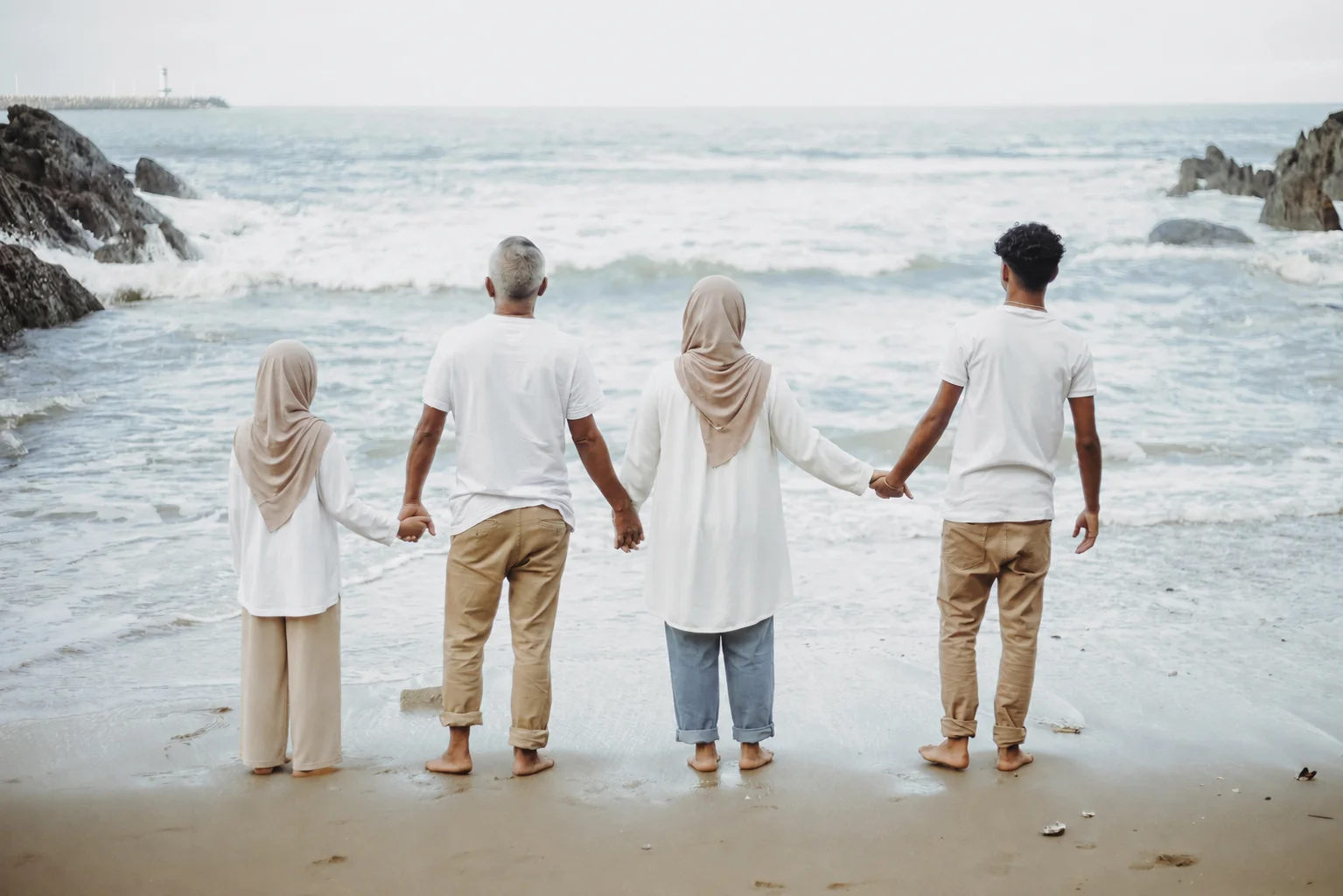


Explore the profound wisdom embedded in Islamic teachings about family, through curated Quranic verses, Hadiths, and sayings from the Ahlulbayt.
A Compilation of Islamic Quotes About Family

Family is where Islam is first lived. Long before a child reads the Qur’an or learns the rules of prayer, they learn what mercy looks like by watching their parents. They learn what tranquillity feels like by watching how their parents speak to each other. They learn what God is like, in part, through the faces nearest to them.
That’s why the tradition treats family with such weight. The Qur’an, the sayings of Prophet Muhammad ﷺ, and the wisdom of the Ahlulbayt return again and again to the same theme: that the home is not a private domain separate from worship. The home is worship, when handled with intention.
What follows is a curated collection of Islamic quotes about family (verses, hadith, and sayings) gathered from primary sources and grouped to help you find what you need. Use them for reflection, for teaching your children, or for the moments when you need to remember why all this matters.
Quranic Verses About Family
The Qur’an’s teachings on family are not a list of rules. They are a portrait of how human beings, given the mercy of belonging to one another, are meant to live.
“And We have enjoined upon man [care] for his parents…” — Qur’an 29:8
“Your spouses are a garment for you as you are for them.” — Qur’an 2:187
“And lower to them the wing of humility out of mercy and say, ‘My Lord, have mercy upon them [parents] as they brought me up [when I was] small.'” — Qur’an 17:24
“And among His Signs is this, that He created for you mates from among yourselves, that you may find tranquillity in them, and He has put affection and mercy between your [hearts]…” — Qur’an 30:21
“It is He who created you from one soul and created from it its mate that he might dwell in security with her.” — Qur’an 7:189
“And We have enjoined upon man, to his parents, good treatment. His mother carried him with hardship and gave birth to him with hardship…” — Qur’an 46:15
“And [mention, O Muhammad], when Luqman said to his son while he was instructing him, ‘O my son, do not associate [anything] with Allah. Indeed, association [with him] is great injustice.'” — Qur’an 31:13
“O you who have believed, protect yourselves and your families from a Fire whose fuel is people and stones…” — Qur’an 66:6
“And those who say, ‘Our Lord, grant us from among our spouses and offspring comfort to our eyes and make us an example for the righteous.'” — Qur’an 25:74
Hadith About Family from Prophet Muhammad ﷺ
The Prophet ﷺ taught family life by living it. The narrations below, many recorded across both Sunni and Shia collections, give us his words on how households should feel, how parents should be honoured, and how mercy moves between generations.
“The best of you is the best to his family, and I am the best among you to my family.” — Prophet Muhammad ﷺ (Tirmidhi)
“There is no greater blessing for a Muslim man after Islam than a Muslim wife who causes him joy when he looks at her.” — Prophet Muhammad ﷺ (Wasa’il Al-Shia)
“He is not of us who does not have mercy on young children, nor honour the elderly.” — Prophet Muhammad ﷺ (Tirmidhi)
“Verily, this womb is derived from the name of the Most Merciful. Whoever severs its relations, Allah will forbid him from entering Paradise.” — Prophet Muhammad ﷺ (Musnad Aḥmad)
“One who pleases his parents has verily pleased Allah, and one who has angered his parents has verily angered Allah.” — Prophet Muhammad ﷺ (Kanzul ‘Ummal)
“Verily, the quickest act of obedience to be rewarded is to maintain family ties, even if the people of the household are wicked, such that it will grow their wealth and increase their numbers if they maintain family ties. No people of a household maintain family ties and remain in need.” — Prophet Muhammad ﷺ (Sahih ibn Hibban)
“The look of a child towards his parents out of love for them is an act of worship.” — Prophet Muhammad ﷺ (Biharul Anwar)
“Verily, the best act of charity is one given to an estranged relative.” — Prophet Muhammad ﷺ (Musnad Ahmad)
Anas reported: The Messenger of Allah ﷺ said in his illness before he passed away, “Your family relations! Your family relations!” (Sahih ibn Hibban)
“One who follows the orders of Allah with regards to obeying parents shall have two doors of Paradise opened up for him. And if there happens to be only one parent, one door of Paradise shall open up for him.” — Prophet Muhammad ﷺ (Kanzul ‘Ummal)
“The one who keeps good relations with family is not the one who is reciprocated. Rather, the one who keeps good relations with family is one who does so despite being cut off by them.” — Prophet Muhammad ﷺ (Sahih Bukhari)
“Whoever is pleased to have his provision expanded and his life span extended, let him keep good relations with his family.” — Prophet Muhammad ﷺ (Sahih Bukhari)
“Kiss your children often, for every display of affection will raise your status in Heaven.” — Prophet Muhammad ﷺ (source)
“Whoever has a child should be like a child with him.” — Prophet Muhammad ﷺ (Wasa’il Al-Shia)
Wisdom from the Ahlulbayt on Family
The household of the Prophet ﷺ (Imam Ali, Sayyida Fatima, Imam Hasan, Imam Husayn, and the Imams who followed) left a body of guidance on family that remains strikingly direct. They speak as people who lived inside families, raising children, navigating loss, and keeping faith in the home through everything.
“He who is deserted by friends and relatives will often find help and sympathy from strangers.” — Imam Ali (Nahjul Balagha)
“The house in which the Holy Qur’an is recited and Allah is remembered, where the inhabitants don’t commit sins, is an auspicious house. The angels keep visiting such houses. The Satan keeps away from there. Satan and his cohorts, in spite of all their efforts, cannot have access to such homes.” — Imam Ali (source)
“Allah has mercy on a parent who loves his child greatly.” — Imam Ja’far Al-Sadiq (source)
“It is the right of your mother that you should appreciate that she carried you [in her womb] the way nobody carries anybody. She fed you the fruits of her heart which nobody feeds anybody. She protected you [during pregnancy] with her ears, eyes, hands, legs, hair, limbs, [in short] with her whole being, gladly, cheerfully, and carefully; suffering patiently all the worries, pains, difficulties, and sorrows.” — Imam Ali Zayn Al-Abidin (Risalat Al-Huqooq)
“No parent has given a better gift to his child than good manners.” — Imam Ali (source)
“Do not cast your gaze upon them except with love and compassion; do not raise your voice above theirs; do not raise your hands above theirs; do not walk ahead of them.” — Imam Ja’far Al-Sadiq (Biharul Anwar)
“The worst of parents are those who transgress the limits in their love and goodness to their children.” — Imam Muhammad Al-Baqir (source)
“Goodness towards the parents is an indication of a person’s excellent cognizance of Allah. This is because there is no worship that can take a person towards the happiness of Allah faster than exhibiting respect towards his Muslim parents for the sake of Allah.” — Imam Ja’far Al-Sadiq (Biharul Anwar)
“Allah shall not accept the prayers of a person who looks at his parents with hatred, even if they have been unfair to him.” — Imam Ja’far Al-Sadiq (Al-Kafi)
“Let your child play up to seven years; and keep him with you for education and training for another seven years; then if he succeeds — well and good; otherwise, there is no good in him.” — Imam Ja’far Al-Sadiq
“A man who has much affection for his child will receive special mercy from God.” — Imam Ja’far Al-Sadiq
Islamic Quotes About Mothers
The Qur’an attaches mention of God to mention of mother more than perhaps any other relationship. The hardship of pregnancy, the years of nursing, the sleeplessness and patience of raising a child: these are named directly, not romanticised. To honour a mother in Islam is to honour what is closest in human experience to mercy itself.
“And We have enjoined upon man, to his parents, good treatment. His mother carried him, [increasing her] in weakness upon weakness, and his weaning is in two years. Be grateful to Me and to your parents; to Me is the [final] destination.” — Qur’an 31:14
A man came to the Messenger of Allah ﷺ and said, “O Messenger of Allah, who among the people is most deserving of my good companionship?” He said, “Your mother.” The man said, “Then who?” He said, “Your mother.” The man said, “Then who?” He said, “Your mother.” The man said, “Then who?” He said, “Your father.” — Prophet Muhammad ﷺ (Sahih Bukhari, Sahih Muslim)
“Paradise lies under the feet of mothers.” — Prophet Muhammad ﷺ (Musnad Aḥmad; Sunan al-Nasa’i)
“It is the right of your mother that you appreciate she carried you the way no one else carries anyone, and fed you from the fruits of her heart what no one else gives anyone.” — Imam Ali Zayn Al-Abidin (Risalat Al-Huqooq)
“The pleasure of the Lord lies in the pleasure of the parents, and the displeasure of the Lord lies in the displeasure of the parents.” — Prophet Muhammad ﷺ (Tirmidhi)
Islamic Quotes About Fathers
The father in Islam is not pictured as distant authority but as an active presence: maintenance, teaching, play, and dignity all named as part of his role. The narrations below speak both of the father’s place in a child’s life and of how children, in turn, are obligated to honour him.
“It is the right of your father upon you that you know he is your root. For without him, you would not be. Whenever you see in yourself something that pleases you, know that your father is the root of its blessing upon you.” — Imam Ali Zayn Al-Abidin (Risalat Al-Huqooq)
“Honour your children and perfect their manners, [and] they will be saved from sins.” — Prophet Muhammad ﷺ (Sunan Ibn Majah)
“No father has given his child a more excellent gift than good manners.” — Prophet Muhammad ﷺ (Tirmidhi)
“On the Day of Resurrection you will be called by your names and the names of your fathers, so give yourselves good names.” — Prophet Muhammad ﷺ (Sunan Abi Dawud)
“A father’s pleasure is from Allah’s pleasure; a father’s displeasure is from Allah’s displeasure.” — Prophet Muhammad ﷺ (Tirmidhi)
Islamic Quotes About Children
Children, in the language of the Qur’an and the Prophet ﷺ, are an amanah: a trust. They are not possessions, achievements, or extensions of their parents’ egos. The tradition’s tone toward children is striking for its softness in an era when softness was rare.
“Wealth and children are [but] adornment of the worldly life. But the enduring good deeds are better with your Lord for reward and better for [one’s] hope.” — Qur’an 18:46
“Whoever is not merciful to our young, nor respectful to our elderly, is not from us.” — Prophet Muhammad ﷺ (Tirmidhi)
“Each of you is a shepherd, and each of you is responsible for his flock.” — Prophet Muhammad ﷺ (Sahih Bukhari)
“A boy must be left to play for seven years, taught the Qur’an for seven years, and must learn lawful and unlawful for seven years.” — Imam Ja’far Al-Sadiq
“The child is the master for seven years; and a slave for seven years; and a vizier for seven years; so if he grows into a good character within twenty-one years, well and good; otherwise leave him alone — you have discharged your responsibility before Allah.” — Prophet Muhammad ﷺ
“He who has a young child should become like a child with him.” — Prophet Muhammad ﷺ (Wasa’il Al-Shia)
The Prophet ﷺ used to kiss his grandsons Hasan and Husayn. A man named al-Aqra’ ibn Habis saw this and said, “I have ten children and I have never kissed one of them.” The Prophet ﷺ looked at him and said, “Whoever does not show mercy will not be shown mercy.” — Sahih Bukhari, Sahih Muslim
Islamic Quotes About Husband and Wife
Marriage in Islam is named directly as a sign of God, one of the explicit signs the Qur’an asks the believer to reflect upon. The household between spouses is meant to be a place of sakinah (tranquillity), mawadda (loving affection), and rahma (mercy). The narrations below speak to how that house is built and held.
“And among His signs is this, that He created for you mates from among yourselves, that you may dwell in tranquillity with them, and He has put love and mercy between your hearts. Indeed, in that are signs for a people who reflect.” — Qur’an 30:21
“They are a garment for you and you are a garment for them.” — Qur’an 2:187
“And live with them in kindness.” — Qur’an 4:19
“The best among you is the one who is best to his wife, and I am the best of you to my wives.” — Prophet Muhammad ﷺ (Tirmidhi, Sunan Ibn Majah)
“When a man marries, he has fulfilled half of his religion. So let him fear Allah regarding the remaining half.” — Prophet Muhammad ﷺ (al-Bayhaqi)
“Whoever is given a righteous wife has been helped to half of his religion, so let him fear Allah for the second half.” — Prophet Muhammad ﷺ (al-Hakim)
How to Apply These Teachings in Muslim Families Today
It is one thing to read these words. It is another to ask what they require. A few patterns emerge when you sit with them long enough.
The household is the first classroom. Long before formal religious education, the child absorbs what they see at home: the way a parent speaks to a spouse, the way they respond to anger, the way they treat strangers. The tradition treats this as the actual curriculum. It is why the Prophet ﷺ said the best of us are the best to our families. The home is where character is verified.
Mercy precedes correction. The single thread running through the narrations on parenting is mercy. Kissing children. Playing with them. Showing them affection openly. The tradition explicitly rejects parenting that leans on shame, fear, or harshness as a primary tool. “Whoever does not show mercy will not be shown mercy.”
You can only give what you have. The most-cited mechanism of Islamic upbringing is not a curriculum or a checklist. It is the parent’s own state: their relationship with God, their adab with others, their handling of their own struggles. Children mirror what is around them long before they understand instruction. Working on yourself is not a distraction from raising your children; it is raising your children.
Family ties are not optional. Across both Sunni and Shia traditions, the maintenance of family relationships, even with relatives who fall short, is repeatedly singled out as among the fastest paths to divine pleasure. The relative who keeps ties despite being cut off, the parent who maintains presence despite difficulty, the sibling who returns again and again: these are the figures the tradition names as honoured.
For a fuller treatment of how these teachings translate into the actual stages of raising a child, see our guide to Islamic parenting, our piece on parenting children through growing independence, our reflections on what the Qur’an teaches us about the treatment of parents, and our piece on the Islamic roles and duties of a Muslim man in the family.
For deeper explorations of specific themes drawn from the Qur’an and the Ahlulbayt, you may also find these collections useful: five verses from the Holy Qur’an on marriage, ten narrations about family in the spirit of Mubahila, ten narrations about seeking knowledge, and fourteen lessons for Muslim men from Imam Ali.
Frequently Asked Questions
What Does the Qur’an Say About Family?
The Qur’an presents the family as one of the explicit signs of God (Qur’an 30:21), commanding good treatment of parents (17:23–24, 29:8, 31:14, 46:15), describing spouses as garments for one another (2:187), and asking believers to safeguard their families from harm (66:6). The Qur’an’s vision of the family is built on tranquillity (sakinah), affectionate love (mawadda), and mercy (rahma): not hierarchy as control, but mutual responsibility under God.
What Is the Most Famous Hadith About Family in Islam?
One of the most widely cited is the Prophet’s ﷺ saying: “The best of you is the best to his family, and I am the best among you to my family” (Tirmidhi). It defines excellence in Islam not by public reputation but by how one is experienced inside the home.
What Does Islam Say About Mothers?
Islam places the mother in a position of singular honour. The Qur’an commands gratitude to her for the hardship of pregnancy and nursing (31:14, 46:15). The Prophet ﷺ named the mother three times before naming the father when asked who deserves the best companionship (Bukhari, Muslim), and is reported to have said that “Paradise lies under the feet of mothers.”
What Does Islam Say About Fathers?
The father’s role in Islam includes maintenance, teaching, dignity, and active presence. The Prophet ﷺ said: “No father has given his child a more excellent gift than good manners” (Tirmidhi). Imam Ali Zayn Al-Abidin’s Risalat Al-Huqooq describes the father as “your root”, the one without whom you would not exist. Honouring fathers is paired with honouring mothers throughout the Qur’an.
What Is the Islamic View of Marriage?
The Qur’an names marriage as a sign of God (30:21), a relationship through which spouses find tranquillity, love, and mercy. The Prophet ﷺ taught that “the best among you is the one who is best to his wife” (Tirmidhi) and described marriage as completing half of one’s faith (al-Bayhaqi). Marriage in Islam is treated as the foundational unit of a God-centred household, not a personal preference but a structural part of religious life. We cover this in full in our guide to marriage in Islam, and our breakdown of the Islamic marriage rules sets out what actually makes a nikah valid.
Why Is Family So Important in Islam?
The family is treated as the first place faith is lived and the first place character is formed. Children learn what mercy, justice, patience, and trust in God look like through their parents long before they learn it from books or teachers. In Islam, maintaining family ties is repeatedly named among the fastest paths to divine pleasure, and severing them among the most serious offences. The household is, in effect, a small ummah, and the larger community is built from it.