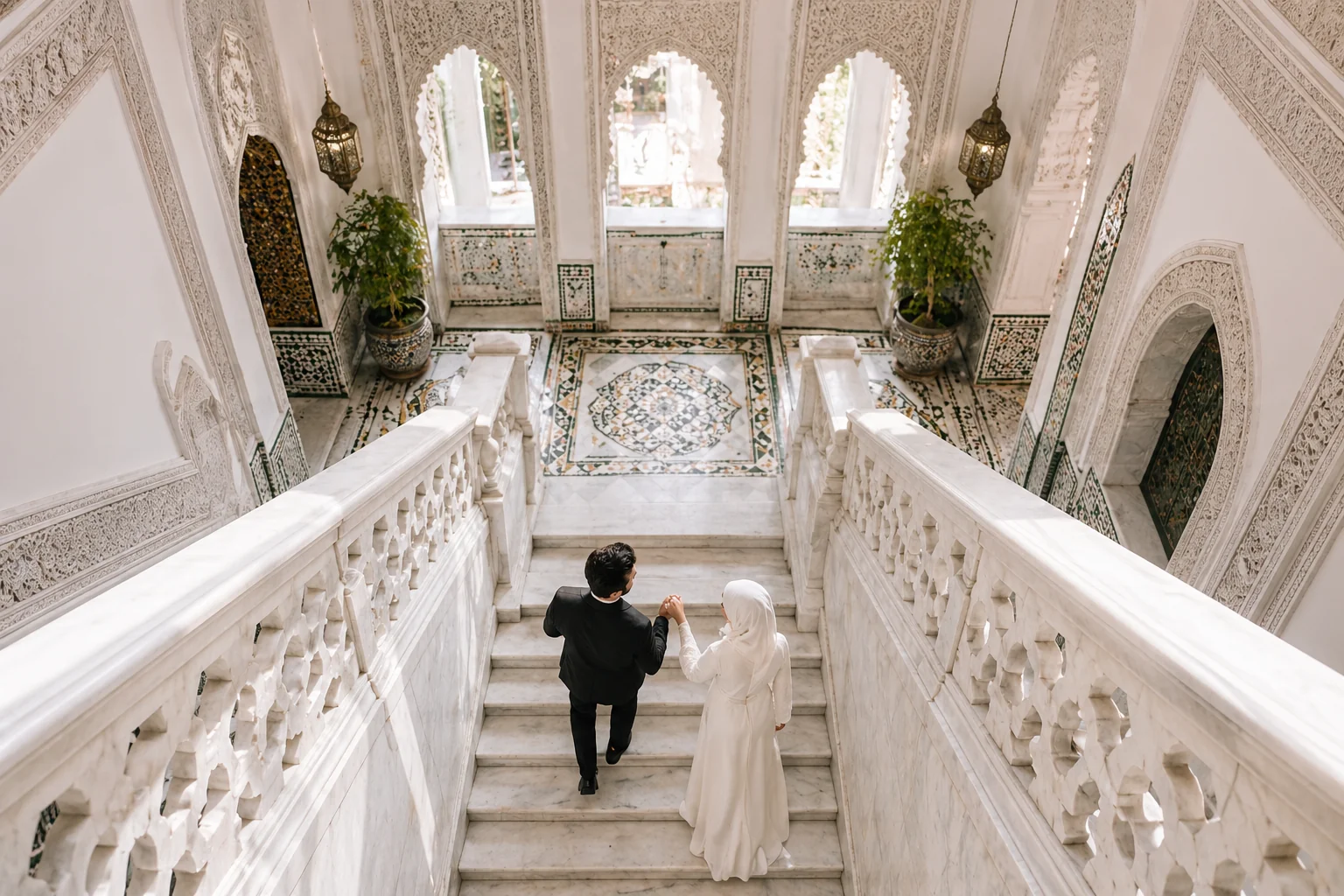
In today’s world, marriage often comes with high costs, societal expectations, and a multitude of challenges. Many of us feel pressure to host extravagant weddings and accumulate material possessions long before marriage. Yet, in the humble marriage of Imam Ali (a) and Sayyida Fatima Zahra (s), tested by poverty, war, and grief, we find enduring inspiration. This piece is shaped by the insights from Sayed Saleh Qazwini’s talk, “Lady Fatima (s) & Imam Ali (a): 5 Secrets of the Most Successful Marriage,” and we have gone back to the sources for each story.
Their marriage was tested like ours, by money worries, war and loss. We have gathered five habits from their home, each with its sources, for couples and for parents preparing their children for marriage.
Choose Allah’s Pleasure Over People’s Expectations
Sayyida Fatima (s) was the daughter of the Prophet Muhammad ﷺ, and many expected a grand match for her. Yet, her wedding to Imam Ali (a) was deeply simple. Their marriage was established with minimal material possessions, as al-Kafi records:
“The Messenger of Allah ﷺ married Ali to Fatima on a Hutami shield, and their bed was made of the hide of a ram.”
al-Kafi, vol. 5, Book of Marriage, ch. 46, no. 3 (our translation), thaqalayn.net
Today, many of us encounter high mahr figures being discussed like business deals, extensive wedding bills, and the need for a house and perfect photos before marriage. The mahr is the bride’s own gift, and it is best kept light and always paid in full. Even small comforts in their home were measured against what Allah loves. It is narrated that:
“The Messenger of Allah ﷺ came to Fatimah and found a curtain hanging at her door, so he did not enter… He replied: What have I to do with this world?… He said: Tell her that she must send it to so-and-so.”
Sunan Abi Dawud 4149, sunnah.com
Fatima (s) immediately sent the curtain to a family in need. This exemplifies her gentle model for a simple Islamic wedding and a modest first home. As Shaheed Sayed Ali Khamenei advises: “Let the marriage of Muslim girls be like the marriage of Lady Fatima (a.s.)… free from any superfluous and hollow luxuries.” No couple is asked to copy their poverty. What we take from their wedding is that faith and companionship come first, and everything else can grow in time.
Ask Only What Your Spouse Can Give
In many societies, excessive expectations can burden a relationship. It is reported that on one day of hunger in their home:
Imam Ali (a), hungry one morning, asked whether there was anything to eat. She said there had been nothing for two days except what she had set aside for him over herself and the boys. He asked, “Fatima, why did you not tell me, so I could find something for you?” She said: “O Abu al-Hasan, I feel shy before my Lord to burden you with what you are not able to do.”
Bihar al-Anwar 43:59 to 61 (our translation), lib.eshia.ir
Imam Ali (a) borrowed a dinar, met al-Miqdad, who had left his hungry children at home, and gave him the dinar. That evening, divine provision supplied a meal for the family, leading the Prophet ﷺ to say:
“O Ali, this is in exchange for your dinar… Indeed Allah provides for whom He wills without reckoning… Praise be to Allah, who did not let you leave this world before rewarding you, and made you, O Ali, follow the way of Zakariyya, and made Fatima follow the way of Maryam, daughter of Imran.”
Bihar al-Anwar 43:59 to 61 (our translation), lib.eshia.ir
This mirrors a Quranic lesson:
“Whenever Zechariah visited her in the sanctuary, he would find provisions with her. He said, ‘O Mary, from where does this come for you?’ She said, ‘It comes from Allah. Allah provides whomever He wishes without any reckoning.'”
Quran 3:37, quran.com
The story encourages us to appreciate what we have, avoiding the burden of unrealistic expectations. The rights and duties of marriage, such as maintenance, kindness, and dignity, are real. Lowering expectations never means accepting neglect, control, or harm. Imam Ali (a) and Fatima Zahra (s) shared work in their home:
“Amir al-Mu’minin would gather firewood, draw water and sweep the house; Fatima would grind, knead and bake.”
al-Kafi, vol. 5, Kitab al-Ma’isha, ch. 11, no. 1 (our translation), thaqalayn.net
Each carried a share of the work, and neither asked the other for more than they could give.
Help Each Other Get Closer to Allah
A marriage focused on nearness to Allah becomes a partnership in spiritual growth. The morning after their wedding, the Prophet ﷺ asked each of them about the other:
The Prophet ﷺ came the morning after their wedding and asked Ali (a), “How did you find your wife?” He said: “The best help in obeying Allah.” He asked Fatima (s), and she said: “The best of husbands.” Then he prayed: “O Allah, gather them together and join their hearts.”
Bihar al-Anwar 43:117 (our translation), lib.eshia.ir
Through their marriage, they helped each other in obedience to Allah. The Quran guides us in maintaining spiritual priorities within the family:
“And bid your family to prayer and be steadfast in maintaining it. We do not ask any provision of you: it is We who provide for you, and to Godwariness belongs the ultimate outcome [in the Hereafter].”
Quran 20:132, quran.com
The Prophet ﷺ prayed for spouses who wake each other for worship, the wife and the husband alike:
“May Allah have mercy on a man who gets up at night and prays, and awakens his wife… May Allah have mercy on a woman who gets up at night and prays, and awakens her husband…”
Sunan Abi Dawud 1308, sunnah.com
We might also go to the mosque or a majlis together, or decide together on a monthly sadaqah, so that our good deeds become shared ones. It is reported, and commentators of the Ahl al-Bayt link these verses to it, that the household fasted three days and each evening gave their food to someone in need at the door:
“For the love of Him, they feed the needy, the orphan and the prisoner, [saying,] ‘We feed you only for the sake of Allah. We desire no reward from you, nor thanks.'”
Quran 76:8 to 9, quran.com
Show Love and Affection, With Balance
In many families, especially traditional ones, a husband might be quick to comment on salt in the food and slow to express kind words. Balance is important: warmth and kind words at home, dignity and modesty in public. The Prophet ﷺ spoke openly of his love for Khadija:
“Her love had been nurtured in my heart by Allah Himself.”
Sahih Muslim 2435b, sunnah.com
Saying it out loud matters too. A narration in al-Kafi suggests, despite its weak chain, the importance of expressing affection:
“The words of a man to a woman, ‘I love you’ never goes away from her heart.”
al-Kafi, vol. 5, ch. 190, no. 59, thaqalayn.net
It is reported that Imam Ali (a) said of Fatima (s):
“By Allah, I never angered her, nor compelled her to anything, until Allah took her; nor did she anger me or disobey me in anything; I would look at her and my cares and sorrows would lift.”
Bihar al-Anwar 43:134 (our translation), lib.eshia.ir
Within our marriages, this can be as simple as a kind word at the end of a long day, a smile, a quick apology, or saying “I love you” without waiting for a special occasion. A husband who notices the salt in the food can notice the effort behind it too, and a wife’s kind words carry the same weight. Warmth belongs inside the home, and dignity and modesty go with us outside it.
Be a Garment for One Another
The Quran describes spouses as a garment for each other, encompassing warmth, protection, and honour:
“They are a garment for you, and you are a garment for them.”
Quran 2:187, quran.com
Spouses who broadcast every argument to parents, siblings, friends or social media do harm that is remembered for years; the quarrel is settled in a day, and the words stay in people’s memories long after. We are reminded to protect each other’s vulnerabilities and keep secrets, nurturing trust and love. Shaheed Sayed Ali Khamenei put it simply in his advice to spouses: “Wife and husband should keep each other’s secrets.”
Abuse, threats, control and oppression are never something to keep hidden, and speaking to a trusted person, a counsellor, a scholar or the police is right. If you are being hurt, threatened or controlled, you are not required to endure it; seek safety and help.
For couples facing ordinary difficulties (no abuse), Hujjat Marital Support in London offers confidential help. Marriage counselling is not the route for abuse cases.
Sayyida Fatima (s) stood as a public defender for Imam Ali (a) in her sermon in the mosque, exemplifying her loyalty and dedication to justice. She fell ill, suffering greatly, and passed away within months of her father. Imam Ali (a) buried her at night, a profound trial for him. It is recorded that, as her death drew near, she spoke with him one last time:
As her death drew near she sat him by her and said: “O son of my uncle, you have never found me lying or treacherous, nor have I gone against you since you lived with me.” He replied: “God forbid! You know Allah better, and are more righteous, more God-fearing and nobler, than that I should reproach you for going against me… Parting from you is hard on me… by Allah, you have renewed for me the loss of the Messenger of Allah ﷺ.”
Bihar al-Anwar 43:191 (our translation), lib.eshia.ir
At her grave, Imam Ali (a) addressed the Prophet ﷺ, calling her a trust returned to him:
“O Prophet of Allah, peace be upon you from me and from your daughter who has come to you and who has hastened to meet you… Now the trust has been returned and what had been given has been taken back. As to my grief, it knows no bounds, and as to my nights, they will remain sleepless…”
Nahj al-Balagha, Sermon 202, thaqalayn.net
Their love carried them through poverty, war and grief, and it is the love we ask Allah to place in our own homes.
Bringing Their Home Into Ours
Their home had little money and much faith. Our homes can carry something of it: a simpler start, fair expectations, worship together, kind words, and loyal privacy that never shelters harm. By looking to our complete guide to marriage in Islam, we can gain more inspiration. May Allah place affection and mercy between us and our spouses, as He promises in Surah al-Rum (30:21), and make our homes places of peace for our children.
Watch the Lecture
For the full lecture by Sayed Saleh Qazwini that inspired this article, watch here:
Frequently Asked Questions
Why is the marriage of Imam Ali and Fatima seen as the ideal marriage in Islam?
The marriage of Imam Ali and Fatima exemplifies balance and harmony, blending faith, simplicity and shared worship. Their lives show loyalty during hardships such as poverty, war and grief. Fatima’s motherhood of the Imams adds to their legacy, offering a model to learn from, without needing to measure ourselves against them.
What was Fatima Zahra’s mahr?
As recorded in al-Kafi, Fatima Zahra’s mahr was a Hutami shield, and their bed was made from a ram’s hide. The mahr represents the bride’s gift and is intended to be manageable and fully paid. While we do not specify amounts, families should agree on a suitable mahr for their situation.
What does “they are a garment for you” (2:187) mean for spouses?
The phrase “they are a garment for you” highlights mutual support and care between spouses, akin to a garment that covers, warms, beautifies and protects. It signifies the importance of keeping each other’s secrets and speaking well of one another, emphasising a balance in mutual respect and care.
Does keeping marital matters private mean staying silent about abuse?
No, keeping marital matters private does not mean remaining silent about abuse. Abuse, threats, control and oppression should never be hidden away. It is right to speak to someone trustworthy, whether a counsellor, scholar or the authorities.
How can couples today follow their example?
Couples can follow their example by having a modest wedding and communicating honestly about expectations, both before and after marriage. Praying together and encouraging each other for Fajr, expressing love through kind words and maintaining privacy in their personal matters are ways to embody their teachings while never hiding harm.