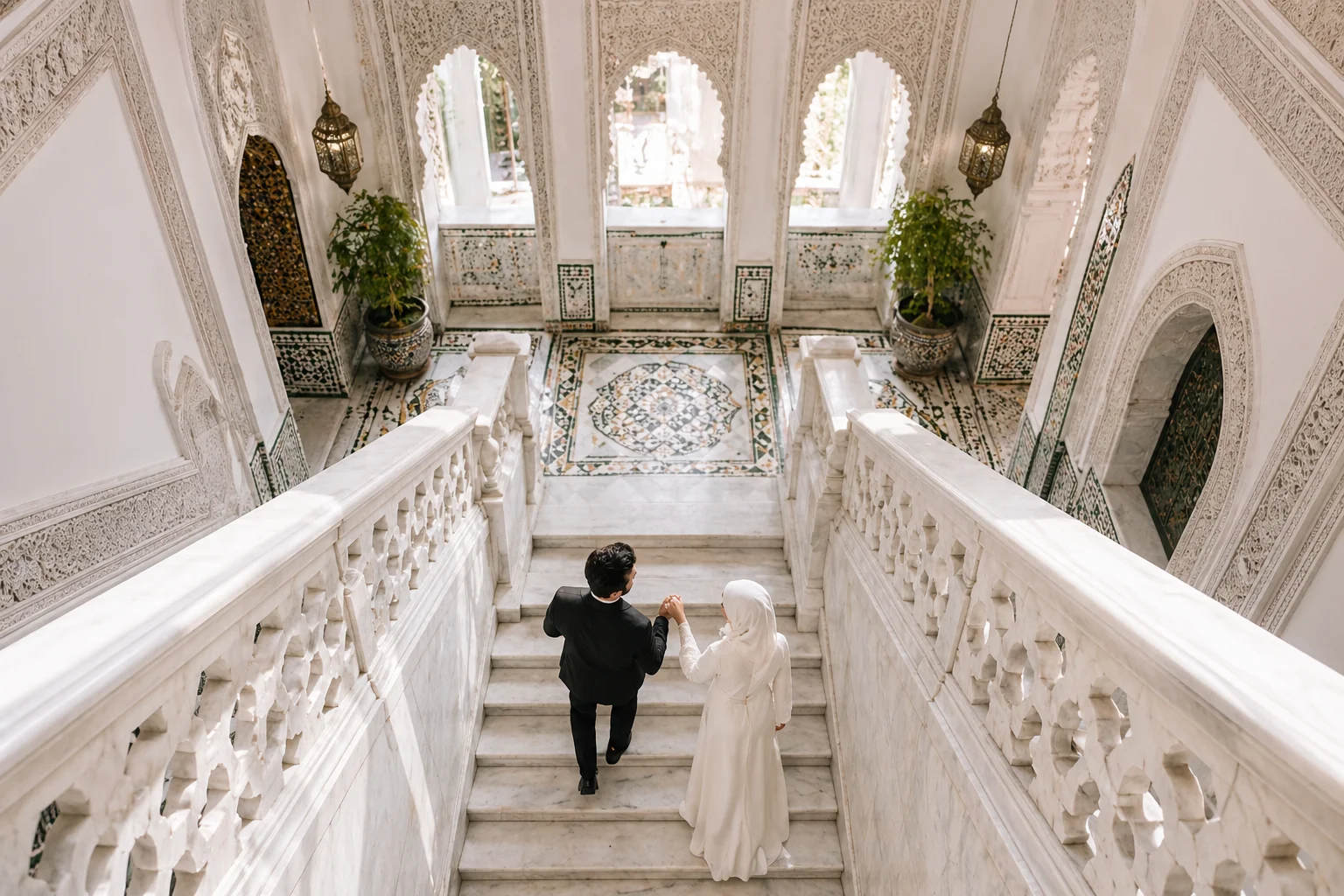


A clear guide to Islamic marriage rules across the major schools — proposal and acceptance, mahr, wali and witnesses, polygamy, mut’ah, and the cultural practices often confused for religious requirements.

Most of us reach the point of arranging a nikah without ever having been taught what the religion actually requires for it. We search, and what comes back is either a watered-down summary or one school’s position presented as though it were universal. Neither helps a Muslim family trying to get this right.
So this guide sets out the rules of marriage in Islam as our major schools of law actually teach them: what makes a marriage valid, where the schools genuinely differ, and which of the expectations we grew up with are cultural rather than religious. This is the fiqh companion to our pillar guide to marriage in Islam, which carries the theological frame, and to our guide to the Islamic wedding, which covers the ceremony and celebration built around the contract.
What Makes a Marriage Valid in Islam?
A Muslim marriage is, in the technical sense, a contract, though a contract carrying religious weight. Our classical schools of fiqh (Islamic jurisprudence) generally agree on the core elements that make a marriage valid, even where they differ on the procedural details. Across the four Sunni schools (Hanafi, Maliki, Shafi’i, Hanbali) and the Ja’fari (Shia) school, the consensus is roughly this:
1. A proposal and acceptance (ijab and qabul). One party offers marriage in clear terms; the other accepts in clear terms. Both must be fully consenting adults of sound mind. The offer and acceptance can be spoken in any language, must be definitive (not conditional on uncertainty), and must occur in the same gathering (majlis).
2. The two parties must be permitted to marry each other. Certain relationships are prohibited (mahram): close blood relatives, certain in-laws, foster relations created by milk-kinship, and others. A woman currently in another marriage or in her post-divorce waiting period (‘iddah) cannot enter a new marriage.
3. The mahr (dowry). A mahr from the husband to the wife must be either named or implied. This is non-negotiable across all schools. A marriage without any mahr, even a token one, is invalid in classical fiqh.
4. The procedural details (wali, witnesses). This is where the schools diverge meaningfully. The next section addresses the differences directly.
Are a Wali and Witnesses Required for an Islamic Marriage?
This is the question we are asked more than any other, and the honest answer is that it depends on which school we follow. The differences here are real, and they matter for families who have members following more than one.
Maliki, Shafi’i, and Hanbali schools. A wali (typically the bride’s father, or in his absence another close male relative) is required for the marriage to be valid. A woman cannot contract her own nikah; a wali must perform the contract on her behalf with her consent. Two trustworthy male Muslim witnesses must also be present. A marriage missing either is, in these schools, invalid.
Hanafi school. An adult Muslim woman of sound mind can contract her own marriage without a wali. The wali’s involvement is strongly recommended and culturally expected, but his absence does not invalidate the marriage. Witnesses are still required.
Ja’fari (Shia) school. An adult Muslim woman of sound mind can contract her own permanent marriage without a wali, and witnesses are not required for the validity of permanent marriage, only for divorce. Witnesses remain strongly recommended, and the wali’s involvement is treated as part of the seriousness expected of the decision, but neither is technically a condition of validity for an adult woman entering her first marriage. The position of a virgin daughter is treated more carefully: many Ja’fari scholars hold that her father’s permission is required as a matter of obligation, even where it does not technically affect contract validity.
What unifies all five positions, despite their genuine differences: no school treats marriage as a private decision made in isolation. Every one of them assumes that family, witnesses, scholars, and counsel are involved in how a marriage is discerned, even where the technical legal requirements vary. The practical advice we would give any family is to know which school you follow, take its specific requirements seriously, and beyond that, treat the involvement of trusted relatives as part of the weight of what is being decided.
What Is the Mahr and How Does It Work?
The mahr is the element our communities misunderstand most. It is a gift from the husband directly to the wife, hers exclusively to keep or use as she chooses, and the Qur’an makes it a condition of the marriage itself. Many of us grew up hearing it described as a bride price paid to her family, which is a cultural inheritance rather than anything the religion teaches:
“And give the women their mahr graciously…” — Quran 4:4
A few things to know:
The mahr belongs to the wife alone. Her father, brothers, or family have no claim on it. Where our customs route it through her family or treat it as a payment owed to them, we have drifted from Islamic practice into cultural practice. The Qur’an says directly that taking back any portion of it without her free consent is forbidden (4:20–21).
The amount is not fixed. Classical jurists disagree on whether there is a minimum (Hanafi: 10 dirhams; other schools: any amount that has economic value), but there is no maximum, and the Qur’an does not require either party to choose a low or a high amount. The Prophet ﷺ did, however, indicate that an excessive mahr is no marker of righteousness. What our scholars are pointing us toward here is a figure that carries dignity for the wife without becoming a display for everyone else.
It can be paid up-front, deferred, or split. A common arrangement is to pay part at the time of the contract (muqaddam) and defer part to be paid at separation, divorce, or death (mu’akhkhar). The terms are negotiated between the parties and recorded in the contract.
It is owed even if not specified. If the parties marry without naming a mahr, the marriage is still valid in some schools (Hanafi most clearly), and the wife is entitled to a “fair mahr” (mahr al-mithl): what would be customary for a woman of her standing and family. Skipping mahr entirely is not an option.
What Is the Nikah Contract?
The nikah itself is a remarkably uncomplicated procedure, and this surprises many of us. There is no priest required, no consecration, no special ceremony mandated by the religion. What is mandated is the elements above: a proposal, an acceptance, a permitted couple, a mahr, and (depending on school) a wali and witnesses. Once these are met, the marriage exists.
This is one reason serious Muslim marriages can, and historically often did, happen with very little ceremony. The walima and the wider celebration are important sunnah practices that follow the contract, and we cover them in our guide to the Islamic wedding. They are separate from the contract itself.
The contract is also where conditions (shurut) can be added, and this is the part we most often see families leave unused. A bride may stipulate that she retains the right to work, to complete her education, to live in a particular city, or that her husband will not take a second wife without her consent. Provided the conditions do not contradict the basic nature of marriage in Islam, they bind once both parties agree, and the husband is religiously obliged to honour them. Our schools differ on the enforceability of certain specific conditions, but the principle that conditions can be written in is broadly accepted across all of them.
For more on the legal rights and responsibilities the contract creates, see our companion piece on the Islamic roles and duties of a Muslim man in the family.
Who Can Marry Whom in Islam?
The Qur’an names the categories of relationship in which marriage is prohibited (4:22–24). The list is more or less identical across our schools and includes:
- Direct blood relatives in the ascending and descending lines (parents, grandparents, children, grandchildren)
- Siblings, aunts, uncles, nieces, nephews
- The same categories through milk-kinship (women who breastfed each other’s children, under specific conditions, become permanently prohibited to one another’s children for marriage purposes)
- A woman currently in another marriage
- A woman in her ‘iddah (post-divorce or post-widowhood waiting period)
- A woman previously divorced three times by the same man, until she has been validly married to and divorced from another man (Quran 2:230); this is a verse often misunderstood and worth careful study with a scholar where it applies
- Direct in-laws (a man cannot marry his wife’s mother, daughter from a previous marriage once he has consummated with the wife, etc.)
The interfaith dimension (whether a Muslim man can marry a non-Muslim woman of the People of the Book, and the universal prohibition of a Muslim woman marrying a non-Muslim) is treated by our classical schools with significant nuance, and it remains under live scholarly debate, particularly for those of us raising families in the West. Because the circumstances are so often individual and the rulings context-dependent, we treat interfaith marriage as a question for a scholar who knows the family rather than one we would answer generically here.
What Does Islam Say About Polygamy?
The Qur’an permits polygamy explicitly:
“…marry those that please you of [other] women, two or three or four. But if you fear that you will not be just, then [marry only] one…” — Quran 4:3
The ruling is plain: a Muslim man may marry up to four wives, on condition that he treats them justly. The Prophet Muhammad ﷺ practised polygamy after the death of Khadija (most of his marriages serving social, political, and protective purposes) and the practice was common among his Companions. Polygamy is, without ambiguity, a permitted form of Islamic marriage.
What Are the Conditions of Polygamy in Islam?
The condition of justice (‘adl) is not symbolic, and our classical jurists treat it as a real, enforceable standard: equal time, equal material provision, equal dignity, equal respect. A man who cannot meet these obligations across multiple wives is religiously obligated to limit himself to one. The Qur’an returns to the question in a later verse:
“You will never be able to be equal in feeling between wives, even if you should strive [to do so]. So do not incline completely [toward one] and leave another hanging…” — Quran 4:129
Our jurists read the two verses together as drawing a careful line: equity in conduct is required and possible; equity in feeling is acknowledged to be beyond complete human capacity. What the man can control (time, treatment, fairness, attention, financial obligation) must be just. What he cannot fully control (the inclinations of the heart) should not be allowed to translate into injustice.
What Modern Challenges Surround Polygamy Today?
The classical permission was given in a context different from the lives most of us are living. A few realities are worth naming honestly.
Legal recognition. Most of the countries our readers live in (the UK, US, Canada, and most of Europe among them) do not legally recognise polygamous marriage. A second nikah in these contexts has Islamic validity but no civil standing, which creates real consequences for inheritance, residency, healthcare access, and children’s legal status.
Economic structure. The classical model of polygamy assumed the husband’s full financial responsibility for each wife and her children. Modern dual-income households, smaller family sizes, and the cost of urban life make meeting this obligation across multiple households genuinely demanding for most men. Where the obligation cannot be met, the religious permission does not extend to the practice.
Consent and disclosure. Classical fiqh varies on whether a husband must inform a first wife before taking a second. The dominant Sunni position has historically held that he is not legally required to, though disclosure is recommended; the Ja’fari tradition tends to weight transparency more heavily. Many modern scholars across schools argue that, in contemporary contexts, non-disclosure introduces a degree of harm and dishonesty that the marriage was not designed to absorb.
Stipulated conditions. A wife may, at the time of the marriage contract, stipulate that her husband will not take another wife without her consent. Where this condition is included and agreed, it becomes binding on the husband across most schools.
What Are the Honest Pros and Cons of Polygamy?
Where polygamy has genuinely served a social purpose, it has typically done so in specific circumstances:
- Societies with significant gender imbalance, particularly post-conflict societies where many men have died and many women would otherwise remain unmarried, including widows with children
- Care of orphans and dependent women within an extended family structure
- Cases where a first marriage cannot produce children and both spouses, with full consent, prefer this path to divorce
- Contexts in which a second marriage is, on balance, a more honest path than the unmarried alternatives the man would otherwise pursue
Where polygamy has caused harm, it has typically done so in specific patterns:
- When the condition of justice is not actually met (material, temporal, or relational unfairness toward one wife)
- When it is entered into without disclosure to a first wife, breaking the trust of the original marriage
- When it is used as a cultural or status marker rather than for the kinds of reasons the Qur’an’s permission contemplates
- When the children of separate households are placed in unequal positions psychologically or materially
- When the religious permission is invoked to legitimise what is, in practice, a moral or relational evasion
Polygamy is rare in most contemporary Muslim societies (under 5 per cent in most surveys) and many Muslim-majority countries impose legal conditions on it (court approval, first-wife notification, evidence of capacity to provide). The permission remains in the Qur’an. Working out when it is the right path, for whom, and under what conditions, is one of the more serious questions a Muslim man and his existing wife can face. The verse establishes the permission and the condition it carries, and everything past that falls to conscience, scholarship, and an honest assessment a couple can only make for themselves.
What Is Mut’ah, and Why Do Sunni and Shia Schools Differ on It?
Mut’ah, also called nikah al-mut’ah or sigheh, is temporary marriage. It is the sharpest fiqh divergence in this whole subject and we want to name it with care. The disagreement is genuine, the scholarship on both sides is substantial, and the answer depends on which school a family follows.
The four Sunni schools hold that mut’ah was permitted in early Islam, at the time of Khaybar or (in some narrations) at the conquest of Mecca, and was subsequently prohibited and abrogated by the Prophet Muhammad ﷺ himself. They cite specific narrations recorded in Sahih Bukhari and Sahih Muslim as the basis for this abrogation, and the public confirmation of the prohibition by the second caliph Umar ibn al-Khattab. From the Sunni position, mut’ah is no longer a valid form of marriage and engaging in it is religiously prohibited.
The Ja’fari (Shia) school holds that mut’ah was permitted in the Qur’an, was practised in the Prophet’s ﷺ time, and was never abrogated by him. Ja’fari scholars cite Quran 4:24 (“And those of whom you seek pleasure (istamta’tum) from them, give them their due…”) as the foundational text, alongside a continuous body of narrations from the Ahlul Bayt affirming its continued permissibility. From this position, the prohibition is attributed to the caliph Umar’s policy rather than the Prophet’s ﷺ teaching. The conditions for a valid mut’ah include a defined duration agreed by both parties, a specified mahr, mutual consent of two adult Muslims, and the requirement that any resulting children inherit and be acknowledged exactly as in a permanent marriage.
This is one of the deeper theological and legal divisions in Islam, and we are not going to resolve it in a summary. Each side reads the relevant hadith corpus, the text of Quran 4:24, and the sequence of historical events differently, and the reasoning runs back through centuries of careful scholarship on both sides. One thing does need naming honestly: in some modern contexts the Ja’fari permission has been misused as a thin religious cover for arrangements that are in practice casual or exploitative, and serious Ja’fari scholars have been vocal in pushing back on exactly that. The classical conditions attached to mut’ah are what distinguish a religiously valid marriage from a casual arrangement, and they were never a loophole.
Anyone navigating this should know which school’s rulings apply to them, take that school’s position seriously, and consult a knowledgeable scholar before acting. We have set the divergence out factually here rather than picking a side.
Is the Walima Required for a Marriage to Be Valid?
After the contract, the Prophet ﷺ encouraged the walima, a marriage feast held to announce the marriage publicly. Its status in fiqh is settled across our schools: a confirmed sunnah, strongly recommended, and not a condition of validity. A couple who never hold one are still fully and properly married.
The Prophet ﷺ said:
“Hold the walima, even if it be with one sheep.” — Prophet Muhammad ﷺ (Sahih Bukhari 5167)
Two rulings around it are worth knowing, because our communities routinely get both backwards. The walima falls on the husband or his family, not on the bride’s family. And accepting an invitation to one, where attending is reasonable, is itself a recommended act rather than an optional courtesy.
What the sunnah is protecting here is publicity. A marriage is meant to be known and witnessed, and secrecy around a nikah invites doubt, dispute, and harm that falls hardest on the wife. That concern is the reason the walima carries the weight it does in our books, whatever scale a family holds it at.
For how the walima is actually held, what the Prophet ﷺ served at his own, and the harder questions our families face today about scale, guest lists, and cost, see our guide to the Islamic wedding.
What Cultural Practices Are Mistaken for Islamic Rules?
One of the most useful things we can do for our families is separate the expectations that are actually religious from the ones we have inherited culturally. The two get confused constantly, and it is almost always the cultural ones that add burdens the religion never asked of us.
Excessive dowry as a marker of seriousness. The mahr is a gift to the wife. The Qur’an does not specify an amount. The Prophet ﷺ indicated that lower mahrs are more blessed. Cultural pressure to extract a large mahr (typically as a status marker for the bride’s family) has no basis in Islamic law.
The bride’s family paying for everything. This is South Asian and some other cultural traditions. Islamic law places no obligation on the bride’s family to fund the wedding, and in fact places no specific funding obligation on the bride at all. The walima is the husband’s responsibility per the sunnah.
The contract requiring an imam. The nikah does not require an imam, scholar, or religious official. Any competent Muslim adult who knows the procedure can perform it. An imam’s presence is customary and often legally required by civil registration, but it is not a religious requirement of the marriage itself.
The “engagement period” as quasi-marriage. Pre-marriage betrothal in Islamic law is not marriage. The two parties remain non-mahram to each other until the contract is performed. Many cultural engagement practices blur this in problematic ways.
Caste, ethnic, or class restrictions. Many Muslim communities, particularly across South Asia and parts of the Arab world, restrict marriages along caste lines (Syed, Sheikh, Khan, Pathan distinctions; Quraysh and tribal hierarchies; biradari networks), ethnic lines (refusing matches across nationalities or skin tones), or class lines (rigid expectations around family wealth or education matching). These restrictions are then often defended to us as kufu’, the classical concept of marital compatibility, which is a misreading of the concept. Our schools differ on the components of kufu’, but the through-line running through all of them is alignment in deen and character. Some include broader social standing; none establish caste or race as an Islamic criterion. The question is closed by the Prophet ﷺ himself, in the Farewell Sermon:
“There is no superiority of an Arab over a non-Arab, nor of a non-Arab over an Arab, nor of a red man over a black man, nor of a black man over a red man, except by piety.” — Prophet Muhammad ﷺ (Musnad Ahmad 23489, graded sahih by Shu’ayb al-Arna’ut; numbering for the Musnad varies by edition)
Where our communities reject marriages on caste, ethnic, or racial grounds, we are following inherited culture rather than Islamic law, and causing real harm to our own young people in the process.
For the spiritual frame that sits underneath all of these rulings, our compilation of Islamic quotes about family and our piece on five verses from the Holy Qur’an on marriage are where many of us start. Our pillar guide to marriage in Islam sets these rules within their broader theological context, and our guide to the Islamic wedding covers the ceremony and celebration that follow the contract.
May Allah make the marriages of our families a source of sakinah, and protect our young people from the burdens we ourselves have added to something He made simple.
Frequently Asked Questions
What Are the Basic Rules of Marriage in Islam?
An Islamic marriage requires: a clear proposal and acceptance between consenting adults of sound mind; the two parties being permitted to marry each other (not within prohibited categories); a mahr from the husband to the wife; and, depending on school, a wali (guardian) and/or witnesses. The Maliki, Shafi’i, and Hanbali schools require both wali and witnesses. The Hanafi school requires witnesses but not a wali for an adult woman. The Ja’fari (Shia) school requires neither for the validity of an adult woman’s permanent marriage, though both are recommended.
Is a Wali (Guardian) Required for Marriage in Islam?
It depends on the school. Three of the four Sunni schools require a wali for the marriage to be valid. The Hanafi school does not require one for an adult woman of sound mind. The Ja’fari (Shia) school does not require a wali for an adult woman’s permanent marriage to be valid, though parental involvement is treated seriously. Across all schools, the wali’s involvement is at minimum strongly recommended.
Are Witnesses Required for an Islamic Marriage?
The Sunni schools require two trustworthy Muslim witnesses for the marriage contract to be valid. The Ja’fari (Shia) school does not require witnesses for the validity of permanent marriage (only for divorce) though witnesses remain strongly recommended in practice.
What Is the Mahr (Dowry) in Islamic Marriage?
The mahr is a gift from the husband directly to the wife, named or implied at the time of the contract, that the Qur’an makes a condition of the marriage (4:4). It belongs to the wife alone. It can be paid in full at the contract, deferred, or split. There is no fixed amount; the principle is dignity rather than display, and the Prophet ﷺ encouraged moderation.
Does Islamic Marriage Require a Specific Ceremony?
No. The marriage requires the contract elements (proposal, acceptance, mahr, and depending on school, wali and witnesses). The walima (the marriage feast) is a confirmed sunnah of the Prophet ﷺ, intended as a public announcement of the marriage, but it is separate from the contract itself. There is no required priest, religious official, or specific ceremony beyond the contract.
What Does Islam Say About Polygamy?
The Qur’an (4:3) permits a Muslim man to marry up to four wives under the strict condition of justice between them. A later verse (4:129) explicitly states that complete emotional equity between multiple wives is not achievable, read by classical jurists alongside 4:3 to establish polygamy as a heavily conditional permission. Our broader treatment on this site frames marriage in Islam as built between two people, with polygamy as a permitted exception under conditions most modern circumstances rarely meet.
Can a Muslim Woman Propose Marriage?
Yes. Khadija bint Khuwaylid, the first wife of the Prophet Muhammad ﷺ, proposed to him through an intermediary. We have clear precedent in our own history for a woman opening the marriage conversation. The procedural rules (wali, witnesses, mahr) apply regardless of who proposed first.